
Why Your Low Back Curve Matters: The Missing Measurement in Chronic Pain
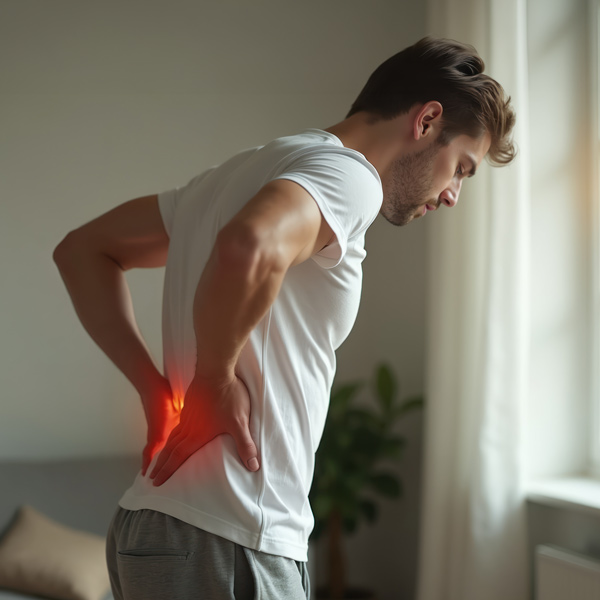
Many people with recurring lower-back pain have been told the same things:
“Your core is weak.”
“Your hamstrings are tight.”
“You need to stretch more.”
“It is just part of getting older.”
Those factors may matter, but they do not tell the whole story.
Your lower back has a normal forward curve called the lumbar lordosis. That curve works together with the pelvis, sacrum, hips, and the rest of the spine to keep your body balanced over your feet.
If the curve is too small, too large, poorly distributed, or mismatched with the shape of your pelvis, the way your spine manages gravity and physical stress can change. Muscles may work harder, certain joints may carry greater loads, and the body may develop compensations to keep you upright.
This is why treating only the painful area may provide temporary relief without correcting the mechanical reason the problem keeps returning.
Your Lumbar Curve Is Part of a Larger System
The lumbar spine is not an isolated stack of five bones. It sits on the sacrum, which is positioned by the pelvis.
One important measurement is pelvic incidence. This describes the anatomical shape of the pelvis and helps determine how much lumbar curvature an individual generally needs to stand in an efficient position.
Pelvic incidence is different from person to person. Someone with a higher pelvic incidence will usually require more lumbar lordosis. Someone with a lower pelvic incidence will generally require less.
That means there is not one perfect lower-back angle for every patient.
The more useful question is:
Does the lumbar curve appropriately match the patient’s pelvic structure and allow the body to remain balanced?
At Apex Chiropractic and Wellness, this relationship is part of the biomechanical picture we consider. Simply labeling a curve as “too much” or “too little” without evaluating the pelvis and overall posture can miss the actual problem.
Think of the Spine Like a Building
A building can remain standing even when part of its foundation is uneven. But other parts of the structure must absorb the stress.
Floors may slope. Door frames may shift. Cracks can appear far from the original problem.
The body responds in a similar way. If the lower spine and pelvis are not well balanced, the body may compensate by:
- Tilting or rotating the pelvis
- Shifting the trunk forward or to one side
- Increasing the curve in another spinal region
- Bending the hips or knees
- Tightening muscles to maintain stability
- Changing walking, lifting, or sitting mechanics
These compensations may allow you to function for years. Eventually, however, the demand can exceed the body’s ability to adapt. That may be when stiffness, fatigue, recurring flare-ups, or persistent pain begin.
The location of pain is therefore not always the location of the primary mechanical problem.
What Research Shows About Lumbar Lordosis and Back Pain
A systematic review and meta-analysis examined 13 studies involving 796 people with lower-back pain and 927 people without it. Overall, those with lower-back pain tended to have less lumbar lordosis.
The relationship was particularly notable in age-matched comparisons and among patients with disc herniation or degeneration. The researchers concluded that reduced lumbar curvature had a meaningful association with lower-back pain. (Chun et al., 2017)
This does not mean every person with a reduced curve will experience pain. It shows that lumbar alignment is a clinically relevant factor—not merely a cosmetic finding.
In a separate population study of 1,491 adults, greater forward displacement of the spine was associated with more lower-back pain, greater disability, and poorer performance on tests involving walking, standing from a chair, grip strength, and single-leg balance. (Hira et al., 2021)
Spinal balance appears to relate not only to pain, but also to how effectively a person moves and performs daily activities.
Alignment Changes How the Spine Is Loaded
When the trunk is balanced, forces can be distributed more efficiently through the spine, pelvis, and lower extremities.
When alignment changes, the muscles must create additional force to prevent the body from falling forward or shifting farther out of balance.
A musculoskeletal modeling study evaluated thousands of spinal configurations and found that changes in global alignment, lumbar curve type, and sacral angle affected compression, shear forces, and spinal-muscle activation at the lower lumbar levels. (Bassani et al., 2019)
In plain language: changing the shape and position of the spine changes how physical stress travels through it.
This is relevant when sitting for long periods, lifting weights, carrying children, playing golf, running, or repeatedly bending at work. The activity may expose the problem, but the underlying alignment may influence where that activity’s force is concentrated.
Why Two People With the Same Pain May Need Different Care
Two patients can both point to the same area of lower-back pain but have very different biomechanics.
One may have:
- Loss of lumbar lordosis
- A forward-shifted trunk
- Disc degeneration
- Pain aggravated by sitting and bending
Another may have:
- Excessive or poorly distributed lordosis
- Pelvic rotation or translation
- Facet-joint compression
- Pain aggravated by standing and extension
A third may have:
- A lumbar curve that does not match pelvic anatomy
- Uneven disc spaces
- A lateral spinal shift
- Sciatic symptoms into the hip or leg
Treating all three patients with the same adjustment, stretch, or exercise routine would ignore these differences.
This is why an individualized biomechanical evaluation matters. The purpose is not simply to find where it hurts. It is to determine how the spine is built, how it is positioned, how it moves, and where it may be compensating.
Why Feeling Better Does Not Always Mean the Structure Changed
An adjustment, massage, or exercise session may reduce pain and muscle tension. That is valuable—but pain relief and structural correction are not necessarily the same outcome.
If the goal is to improve the lumbar curve or overall spinal balance, care must be designed specifically for that structural pattern.
Chiropractic BioPhysics®, or CBP, may use a combination of:
- Individually selected spinal adjustments
- Mirror-image postural exercises
- Corrective spinal traction
- Home-care procedures
- Postural and functional measurements
- Follow-up imaging when clinically appropriate
Each component serves a different purpose. Adjustments improve joint movement. Exercises train muscles and posture. Corrective traction applies sustained forces intended to influence spinal alignment and supporting tissues over time.
The care plan should be based on the patient’s measurements—not on a one-size-fits-all idea of “good posture.”
Can the Lumbar Curve Be Improved?
Research suggests that alignment-directed rehabilitation can produce measurable changes in selected patients.
A randomized controlled trial studied 64 patients with an L5–S1 disc herniation, radiating leg symptoms, and reduced lumbar lordosis. One group received lumbar extension traction in addition to other therapies, while the comparison group received the therapies without corrective traction.
The traction group experienced greater improvements in lumbar curvature, back and leg pain, disability, neurological measurements, mobility, and intervertebral movement. Differences between the groups remained at the six-month follow-up. (Moustafa and Diab, 2013)
This does not mean extension traction is appropriate for every person with lower-back pain. Patients with excessive lordosis, extension intolerance, instability, or other conditions may require a different approach.
It does demonstrate an important principle: when a meaningful structural abnormality is present, specifically addressing that abnormality may improve outcomes beyond symptom-focused treatment alone.
Why Apex Measures Before Making Recommendations
At Apex Chiropractic and Wellness, we evaluate more than the painful spot.
Depending on the patient’s history and clinical needs, the evaluation may include:
- Lumbar lordosis
- Pelvic incidence and sacral angle
- The relationship between the pelvis and lumbar curve
- Forward or lateral trunk translation
- Pelvic height, rotation, and translation
- Disc spacing and degenerative changes
- Lumbar range of motion
- Orthopedic and neurological testing
- Balance and functional limitations
When imaging is clinically appropriate, it allows us to measure spinal structure rather than estimate it from appearance alone.
We can then build a plan around what the patient actually needs—whether that involves corrective chiropractic care, spinal traction, exercise, decompression, co-management, or referral for additional evaluation.
Follow-up measurements help determine whether the plan is creating objective change, not merely a temporary reduction in symptoms.
Chronic Back Pain Deserves a Biomechanical Explanation
Your lower-back curve is not the only factor involved in back pain, but it is an important one.
The lumbar spine must match the pelvis, support the trunk, distribute force, and remain balanced with the rest of the body. When that relationship is disrupted, the body may compensate long before significant pain develops.
If you have recurring lower-back pain, stiffness, sciatica, difficulty sitting or standing, or repeated flare-ups despite previous treatment, it may be time to look beyond the painful area.
At Apex Chiropractic and Wellness, our goal is to identify the mechanical factors contributing to your condition and develop a plan based on measurable findings.
Ready for a more complete evaluation of your lower back?
Contact Apex Chiropractic and Wellness in Carmel to request a comprehensive spinal and biomechanical assessment. We serve Carmel, Zionsville, Westfield, Fishers, and the Indianapolis Northside.
This article is for general educational purposes and does not replace an individualized examination, diagnosis, or medical advice. Treatment recommendations and outcomes vary according to each patient’s condition.
Recommended internal links
- Back Pain: https://apexchiroin.com/back-pain
- Corrective Chiropractic: https://apexchiroin.com/corrective-chiropractic
- Chiropractic BioPhysics: https://apexchiroin.com/cbp
- Spinal Decompression: https://apexchiroin.com/spinal-decompression
- Sciatica: https://apexchiroin.com/sciatica